
One Piece banned pair April 2026: a game-time fix, not just a power nerf
Bandai's April 10, 2026 restriction update did something worth noticing — it banned a pair of cards, not individual cards. OP07-115 "I Re-Quasar Helllp!!" and EB04-058 "Borsalino" can no longer exist in the same deck. Both cards remain legal on their own. That distinction matters more than most players realize, because it tells you exactly what Bandai was trying to fix: not power level, not win rate — game time.
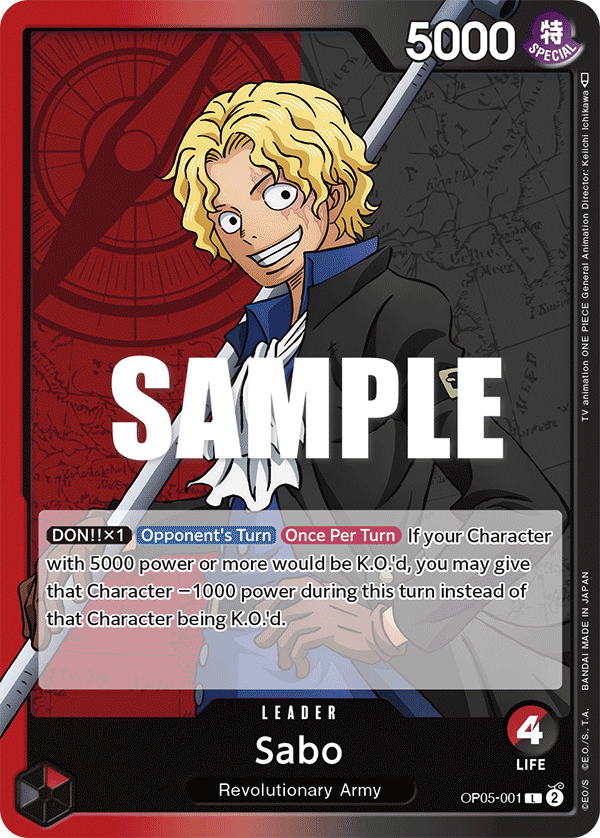
What the combo actually did
The interaction between OP07-115 and EB04-058 created a loop that Yellow decks could exploit to extend games well past comfortable round timers. Borsalino's ability to recur resources combined with "I Re-Quasar Helllp!!" created board states that were extraordinarily difficult to close out. The defending player was not necessarily winning these games — they were just not losing them on any reasonable schedule. Matches involving the pair routinely went to time, and in tournament settings, going to time is not a neutral outcome. It warps standings, exhausts opponents, and turns event logistics into a nightmare for organizers. If you have ever judged a tournament where three tables are still playing twenty minutes after time is called, you know exactly the problem Bandai is addressing here.
Why a pair ban instead of a straight ban
This is where Bandai's approach gets interesting. A traditional ban removes a card from legal play entirely. That is a blunt instrument — it solves the problem, but it also kills every other deck that used the card for non-degenerate purposes. A pair ban is a scalpel. It says: these two cards are individually fine, but together they produce an interaction we do not want in the format. OP07-115 remains available for decks that use it without Borsalino. EB04-058 remains available for builds that do not pair it with "I Re-Quasar Helllp!!" The deckbuilding space stays wider. More cards stay playable. Players who invested in either card individually are not left holding dead cardboard.
This is not a new concept in card games — Magic: The Gathering has used companion restrictions and format-specific bans that function similarly, and the One Piece Card Game itself has used pair restrictions before. But the reasoning behind this particular ban is what makes it notable. Bandai's official statement explicitly cited game time concerns rather than competitive dominance. The combo was not winning at an unacceptable rate. It was making tournaments unplayable at a logistical level.
Pace-of-play as a balance axis
Most players think about balance in terms of win rates and metagame share. A deck that wins 60% of its matches gets nerfed. A card that appears in 40% of top-cut lists gets banned. That is the traditional framework, and it is useful. But it is incomplete. Game pace is a separate axis of format health, and Bandai is treating it as one. A format where every match finishes in 25 minutes is a fundamentally different play experience from one where 15% of matches go to time. The first format feels clean and decisive. The second feels like a slog, and it disproportionately punishes aggressive strategies that need to close games before time is called. By targeting the specific pair responsible for the longest game states, Bandai is protecting the viability of aggressive and midrange archetypes that cannot afford to play long games.
This also matters for spectator experience and stream coverage. One Piece Card Game has been expanding its event broadcast presence, and nothing kills viewer engagement faster than watching a Yellow deck loop for fifteen minutes with no lethal in sight. Pace-of-play restrictions are, in part, a product quality decision.
What this signals about Bandai's competitive philosophy
Read between the lines and you can see Bandai developing a more nuanced approach to format management than the early days of the game suggested. The One Piece Card Game launched fast and sometimes felt like balance decisions were reactive — waiting for problems to become obvious before acting. This pair ban is different. It is targeted, it is specific about the problem it solves, and it preserves as much of the card pool as possible. That is the mark of a development team that is learning from both its own history and the mistakes of other card games.
It also sets a precedent. If Bandai is willing to use pair bans to address game-time issues, then future cards that create similar loop states are on notice. Designers know the tool exists. Players know the standard. And tournament organizers know that Bandai is at least listening when round timers become a problem. We are not calling this a permanent shift in philosophy — one data point does not make a trend. But it is a data point worth tracking, because the alternative is a game where the optimal competitive strategy is to bore your opponent into a draw, and nobody wants to play that game twice.
Practical impact on deckbuilding
If you were running the pair, you now have a decision to make. OP07-115 without Borsalino loses its recursive engine — it becomes a strong card in a vacuum but not the game-stalling machine the combo enabled. EB04-058 without "I Re-Quasar Helllp!!" retains its utility in Borsalino-centric builds that were not abusing the loop. The question for Yellow players is whether either card justifies its slot without its partner. Early deckbuilding chatter suggests most competitive Yellow lists will drop both and retool, but there is space for creative builders to find new shells for either card individually.
The restriction takes effect May 1, 2026. Full details are on the official restriction announcement page.
— Barnaby has been going to time since before it was a balance issue.
Comments
Loading comments…