
MTG Commander — the format, the decks, and how to actually play it
Commander is the reason most people still buy Magic cards. It's a four-player, free-for-all format built around a 100-card singleton deck — no duplicates except basic lands — led by a legendary creature called your Commander. That commander lives in its own zone, costs extra to recast if it dies, and defines which colors you can play. It sounds like a lot of rules, but the appeal is simple: you get to build big, weird, personal decks and play them against three other people doing exactly the same thing. No two games are alike. No two tables are alike. And the format has been growing for fifteen years straight.
The rules in brief
- 100 cards total, including your Commander. One copy of each card (except basic lands).
- Your Commander's color identity — the colors in its mana cost and rules text — determines which cards are legal in your deck. A blue-green Commander means no red, white, or black cards.
- Start with 40 life. Players are eliminated when they reach 0. Last player standing wins — or the group decides the game is over, which is equally valid.
- Commander damage: deal 21 combat damage from a single Commander to any player, and that player loses. This matters in the late game.
- If your Commander would go to the graveyard or exile, you can send it to the Command Zone instead and recast it later for an additional {2} per previous casting.
Where to start: preconstructed decks
Wizards of the Coast releases Commander preconstructed decks — fully playable 100-card decks at a fixed price, usually $45–60 MSRP — with every major set. These are the standard entry point. A precon is balanced to play against other precons, contains a few genuinely powerful cards, and teaches you the format with a coherent strategy out of the box. Recent precon lines have come with Duskmourn, Bloomburrow, Aetherdrift, and others. Each set typically includes four decks covering different strategies and color combinations.
Precons occasionally contain exclusive cards — new designs only available in that product. When those cards are powerful enough for Commander broadly, demand from the format's millions of players can push prices up after the print run sells out. Fierce Guardianship, Deflecting Swat, and Jeska's Will all followed this arc. If you're buying a precon, check what exclusive cards it contains. If you're buying singles, check whether the card you want has been reprinted since its precon debut.
Commander Brackets — the power level system
Commander is a social format, which means power level mismatches are the format's biggest source of friction. A tuned "cEDH" (competitive EDH) deck running infinite combos on turn 3 sitting down with three precon players is not a fun game for anyone. In early 2025, Wizards and the Commander Format Panel introduced the Commander Brackets system: four tiers of deck power, designed to give players a common vocabulary before the game starts.
| Bracket | Power level | What it looks like |
|---|---|---|
| 1 — Exhibition | Casual / introductory | Precon-level or below. No staples, no synergy optimization. Play for fun or to learn. |
| 2 — Core | Upgraded precon | Precon with some upgrades. Consistent themes, some staples, no broken combos. |
| 3 — Advanced | Optimized / tuned | Focused synergies, powerful staples, faster mana. Can close games efficiently. No infinite combos. |
| 4 — cEDH | Competitive | Broken. Optimized mana, fast combos, tutors for everything. Everyone in the pod should be on this level. |
The system is honor-based — there's no algorithm reading your list. But having a shared language matters. Before you sit down with strangers at an LGS, ask "what bracket are you playing?" It saves grief.
Staples: the cards that go in almost every deck
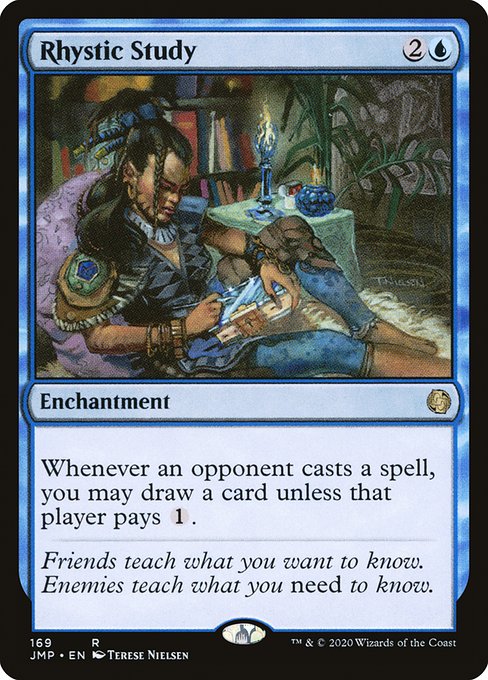
Commander decks need three things at a functional level: ramp (produce more mana), card draw (refill your hand), and interaction (answer what opponents do). The format's staple landscape exists to fill these slots across all color combinations.
Ramp staples
- Sol Ring — {1} artifact, tap for {2}. Colorless. Goes in literally every Commander deck. Has been reprinted hundreds of times; budget copies are cheap.
- Arcane Signet — {2} artifact, taps for one mana in your Commander's color identity. Efficient and universal.
- Cultivate / Kodama's Reach — green sorceries that fetch two lands. Green ramp foundation for any green deck.
- Mana Crypt — the premium colorless rock. {0} cost, taps for {2}. Expensive to buy. Common in cEDH and Bracket 3.
Card draw staples
- Rhystic Study — the enchantment pictured above. Opponents pay {1} or you draw. One of the most powerful draw engines in the format. You'll hear "did you pay the 1?" at every table.
- Phyrexian Arena — pay 1 life per upkeep, draw a card. Reliable black draw engine; less interactive than Rhystic Study.
- Guardian Project — draw when nontoken creatures enter if none share a name with creatures you control. Excellent in creature-heavy singleton builds.
- Consecrated Sphinx — draw two cards whenever an opponent draws a card. Immediate threat; usually answered quickly.
Interaction staples
- Swords to Plowshares — exile a creature for {W}. The gold standard single-target removal in white.
- Counterspell — {U}{U}, counter target spell. The blue interaction baseline; more accessible now than ever with reprints.
- Cyclonic Rift — the overloaded version bounces all non-land permanents you don't control. {7} for a one-sided board clear. This card ends games and ends friendships.
- Fierce Guardianship — free counterspell if you control your commander. From the Ikoria precon free-spell cycle; requires no mana when your commander is in play.
How to build your first Commander deck
Start with a precon or pick a legendary creature you find interesting. Use EDHREC.com — a crowd-sourced database of Commander decklists — to see the most commonly played cards for that Commander. Build toward your Commander's theme first, then fill in ramp, draw, and interaction. The standard framework: roughly 10 ramp pieces, 10 card draw pieces, 10 interaction pieces, 30+ cards that advance your theme, 35–38 lands. Adjust to taste.
Commander is a format you learn by playing. Your first deck doesn't need to be perfect — it needs to be fun enough that you want to play again. Buy the precon, sleeve it up, play a few games, then upgrade the pieces that feel weak. That cycle of play-and-upgrade is what keeps the format moving and the market healthy. We're not telling you what to build. We're giving you the map. Scroll down for the Rhystic Study chart — a useful benchmark for the format's price ceiling on a single card. Happy commanding.
Comments
Loading comments…